- in the index (.toc) pointing to the same id with #anchor.
No new files need to be created and nginx/sitemap don't need updating for each sector.
Adding a new solution to an existing sector:
Add a
- inside that sector's "How askacharge.com solves it" list. Nothing else.
Each solution must correspond to something the platform actually does (check
backend/CLAUDE.md if in doubt) — do not add benefits that don't exist yet.
-->
askacharge.com is not designed for a single type of customer. Any business with parking spaces and a desire to offer EV charging can use it — what differs from one sector to another is the main challenge and the best way to charge. This page grows every time we identify a new sector or a new solution for one already listed.
What it looks like
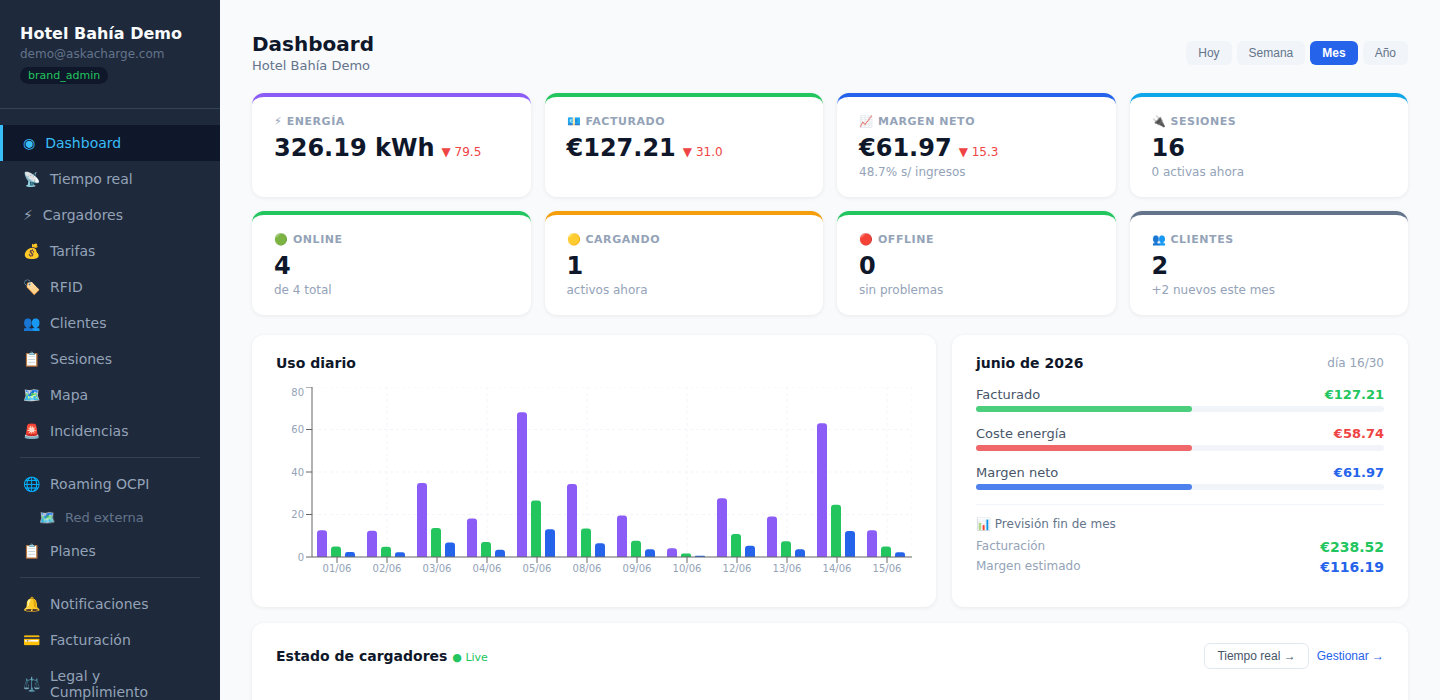
Your dashboard: billing, energy and chargers in real time 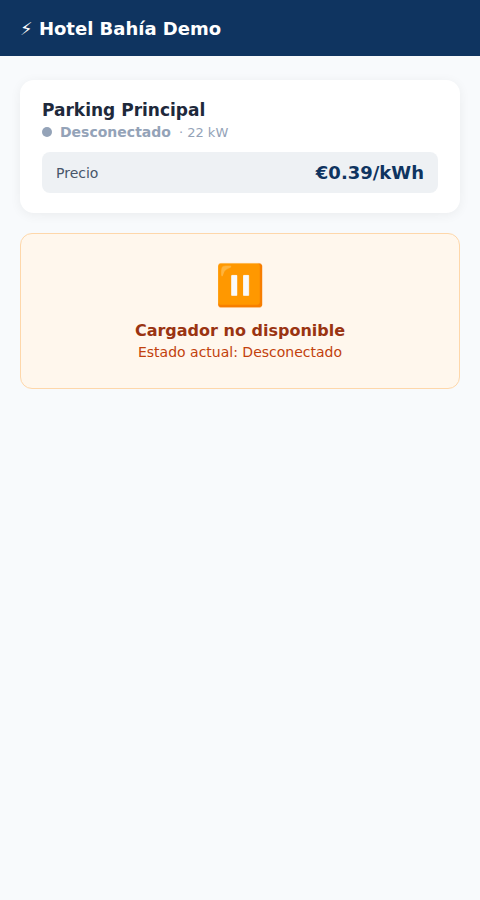
The driver scans the QR and charges, no account needed 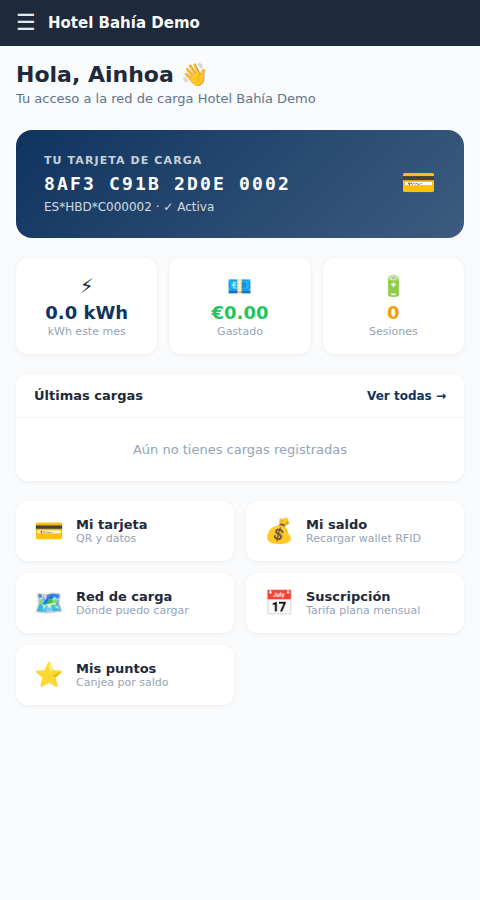
Driver portal: card, consumption and subscription 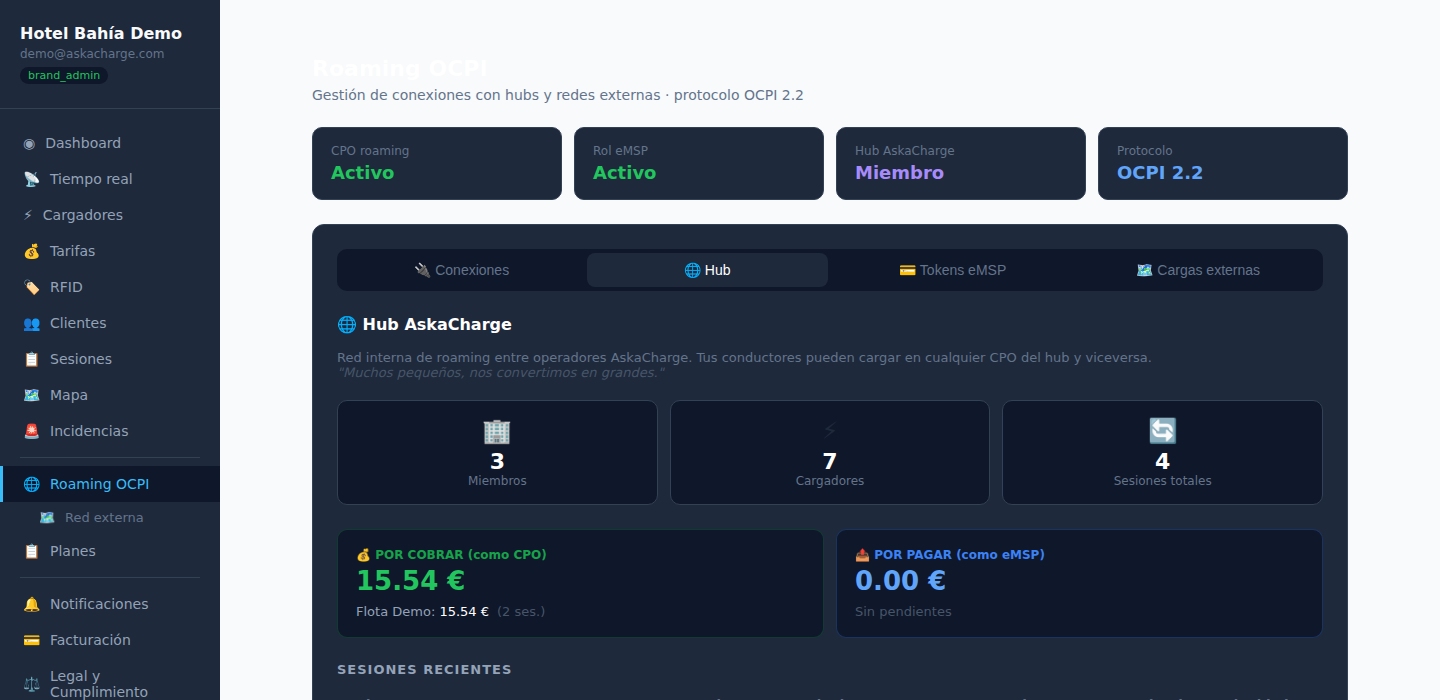
Roaming: your drivers charge on other operators' networks and vice versa ES ENRestaurants
The challenge: a charger alone won't fill tables — the value lies in what happens around it.
How askacharge.com solves it
- Free or subsidised charging while diners eat: indirect billing — the driver who charges stays longer and spends more.
- QR payment with no account for the passing visitor who just wants a quick top-up.
- The public charger map makes you visible to EV drivers looking for somewhere to charge and eat at the same time, bringing in customers who wouldn't have found you otherwise.
How to charge
Free as a draw, or per_kwh / per_session if direct monetisation is preferred.
Hotels
The challenge: different guests expect different payment options — the business traveller is not the weekend tourist.
How askacharge.com solves it
- Multiple tariff models at the same time: free as an amenity (justifying a higher room rate), per session for occasional guests, and aggregated monthly billing for corporate accounts.
- Reservations (ReserveNow) to guarantee a charging spot for a specific guest during a specific time slot.
- Power sharing across multiple garage bays when available grid capacity is limited.
How to charge
Mixed: included in the room rate, per session, or monthly billing for companies — from a sales perspective, offering all three options covers every guest profile without having to pick a single policy.
Campsites
The challenge: pitches spread across a large site, limited electrical capacity, and demand spikes during peak season.
How askacharge.com solves it
- Power sharing (Smart Charging / SPL): multiple pitches charging simultaneously without upgrading the site's grid connection.
- Billing per session or per kWh, consistent with how other campsite services (water, pitch electricity) are already charged.
How to charge
Per kWh or per session, integrated into the same "pitch services" billing logic the campsite already uses.
Small fleets (delivery, services)
The challenge: many vehicles charging overnight at the same depot, and someone needs to justify the spend and avoided emissions to the end customer or the finance department.
How askacharge.com solves it
- Aggregated monthly invoicing per fleet client instead of charging session by session.
- Prepaid wallet per driver, with automatic card charge if the balance doesn't cover the session.
- CO₂ savings report ready for sustainability reporting.
- Power sharing when multiple vehicles charge simultaneously at the same depot.
How to charge
Aggregated monthly billing — the option that genuinely cuts administrative work compared to billing each session individually.
Petrol stations / service stations
The challenge: high customer turnover with no appetite for creating an account, and a European regulatory requirement to accept contactless card payments.
How askacharge.com solves it
- Physical payment terminal (EMV/NFC) integrated, not just QR — relevant because the EU AFIR regulation requires card payment at public fast chargers.
- QR payment as an alternative for those who prefer their phone.
- Billing per kWh, consistent with how fuel is already sold.
How to charge
Per kWh, with a physical terminal as the primary payment option.
Shopping centres / retail
The challenge: similar to restaurants (more time inside = more sales), but at a scale with many more spaces and, typically, a loyalty programme already in place.
How askacharge.com solves it
- Loyalty points per kWh charged, configurable to plug into the centre's existing loyalty programme.
- Public map that specifically draws EV drivers to that centre over competitors.
- Power sharing for large car parks with many EV bays.
How to charge
Free or reduced-price funded by the centre, with loyalty points as a measurable return.
Offices / business parks / coworking
The challenge: offering a benefit to employees or tenants without the building's electrical installation falling short when several charge at the same time.
How askacharge.com solves it
- Power sharing across multiple employee bays without upgrading the building's installation.
- Free or discounted tariff as a staff benefit, or billing to the tenant company if the building has multiple occupants.
How to charge
Free as a benefit, or monthly billing to the tenant / company.
Paid car parks
The challenge: they already charge for parking — EV charging needs to add value, not complicate the existing ticket.
How askacharge.com solves it
- Charging as a premium tier on top of the existing parking ticket.
- Restricted access (subscribers or card holders only) if opening charging to everyone is not desired, or public if the goal is to attract new traffic.
- Revenue share if the car park does not operate the charger directly but leases the space to an external operator in exchange for a percentage of each session.
How to charge
Per session or per hour, as a complement to the standard parking ticket.
Residential buildings
The challenge: several residents want to charge, the building's electrical installation is what it is, and the law prevents the owners' association from blocking the installation of a charging point.
How askacharge.com solves it
- Power sharing (SPL) compliant with IEC 61851 and national grid regulations: multiple chargers without upgrading the building's grid connection.
- Individual billing per bay / resident, without the building manager having to apportion costs manually.
How to charge
Per kWh, billed individually to each owner using their bay.
Chargers already installed, out of service
The challenge: according to ANFAC's e-mobility barometer, between 24% and 31% of public charging points in Spain are out of service (in some regions, such as the Balearic Islands, the figure exceeds 45%). This is not a hardware problem — the charger is almost always physically intact. What fails is the management software: the original installer disappeared, the platform it connected to shut down, or there was never any monitoring or alerting, and the owner ended up with an already-paid asset turned into a dead charger.
How askacharge.com solves it
- Reconnection without touching the hardware: because askacharge.com speaks OCPP 1.6J and 2.0.1 natively, in most cases it is enough to repoint the charger to a new, working backend — no new physical equipment needs to be bought or installed.
- Real-time outage detection (heartbeat every 5 min) and automatic email/Telegram alerts from day one, so the same thing doesn't happen again.
- Integrated incident management to track each fault through to resolution, rather than finding out about the problem when a customer complains.
- The charger reappears on the askacharge.com public map as soon as it is back online — recovering the demand it was losing while it was down.
How to charge
Commissioning / diagnostic service (same pattern as the configuration services in the catalogue), followed by the standard monthly subscription once reactivated — the owner recovers an asset they had already paid off, without taking on a new installation.